History
Pleasant Township was originally populated by Wyandot and Delaware Indians, but the rich, fertile soil made it desirable for homesteading. The first white settler we know about in the area was William Green, who came in the late 1700s. As more settlers arrived, some of the Indians stayed, trying to hold on to what they believed was their land in spite of the Treaty of Greenville. When the resources necessary to sustain them in the area were finally depleted, they moved on peacefully.
Some of the earliest settlers in the area were the Hubers, Hampsons, Hites, McNaughtens, Ashbrooks, Geigers and Ruffners. Most of these families arrived in the early 1800s, having received land grants from President Thomas Jefferson. John Hampson received a grant of 160 acres in 1804; the Hampson Cemetery is named for his family. Aaron Ashbrook came by wagon from Hampshire County, Virginia in 1805, and that same year Adam Geiger from Woodstock, Virginia settled in Walnut and Pleasant Townships. Geiger had 16 children and received a grant of 640 acres. The old cemetery at the north end of the village is named for his family, and a brick home built by Jacob Geiger still stands at the edge of the village. Michael Ruffner came to the village in 1807.
In 1808, James Hampson began operating the first gristmill in Pleasant Township. Another gristmill was operated later by the Ruffner family, and that structure is still standing.
The section that is now the original town of Pleasantville was granted to Jacob Lamb on November 21, 1808 from the U.S. Land Office. It was sold on August 21, 1821 to James Rogers and his wife Nancy for $100. They deeded over five acres of land to John Boston. On this five acres, John Boston and surveyor Ewel Jefferies laid out the village in 1828. It was first called Vicksburg, then New Boston. Eventually it became Pleasantville — from the township where it is located and from Pleasant Run, the principal stream in the area.
Boston secured help from George Sanderson, who had carried the mail over Zane's Trace and was familiar with the land. Lots were offered for sale on October 6, 1828. Seventeen of the twenty-five were sold at auction, ranging from $2.00 to $26.00 each, and the village was dedicated the following day. John Boston built the first house in the village and the first church, a log structure, in 1829.
In 1832, John Tenant opened the first store; the first hotel was owned and operated by John Spitler. Other early merchants were Fredrick Lamb and G.P. Hartman. The first post office opened in 1840. A stagecoach shop was built in 1843, which brought in more settlers. In 1849 a frame church building was built that has since served as an opera house, a furniture store and an upholstery shop, and is now a modernized private home. The first Methodist congregation was organized about 1858 by Reverend J.H. Hamilton.
In 1879, the Toledo & Ohio Central Railroad was built through the village, and the location of the depot caused the town to shift eastward toward the railway. By 1883, Pleasantville contained a flour mill, two churches, multiple dry-goods and grocery stores, a drug store, a blacksmith shop, wagon maker, harness shop, canning mill, carriage shop, hardware store, two shoe shops, two barber shops, a marble factory and a funeral home complete with a horse-drawn ambulance operated by the Hampson family. The Wildermuth Hardware Store was built in 1890.
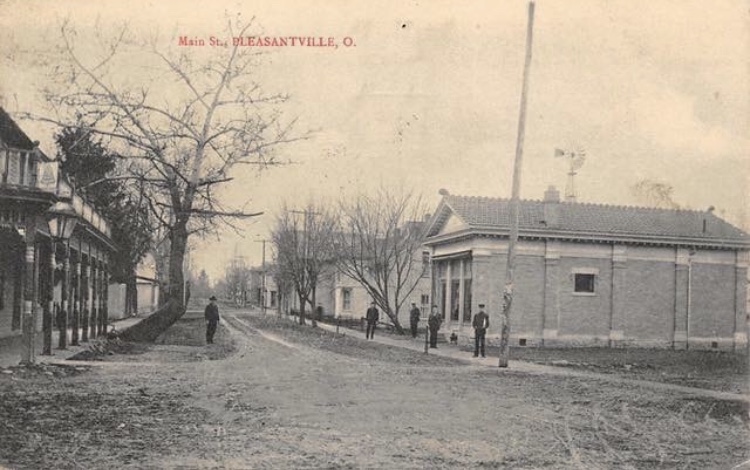
The first road in the area was built in 1803 and was called the Lancaster and Newark Pike. It later became the Lancaster–New Salem Road, although some still call it the Pleasantville Road. Today it is known as Ohio Route 188, or Lancaster–Thornville Road, which is Main Street in the village.
The village was incorporated in 1886, and the first mayor was David Pence. During the Spanish-American War (1898–1899) an Army platoon trained in Pleasantville, and later, during World War I (1917), Co. D 7th Ohio Infantry was housed in Pleasantville at the old Academy.
Education
In Pleasantville's early years, education was a main focal point. The Fairfield Union Academy was an early school of higher learning, organized in 1860 and meeting in the Odd Fellows hall. The first academy building was erected in 1861 on land granted by John and Catherine Ashbrook. The academy served the community until the summer of 1903, when it held its last commencement. It had two brick buildings — a dormitory and a building with a chapel, recitation room, cabinet and society rooms. Tuition was $8.00 per three-month term, rooms $2.00 per week and board $1.50 per week. The buildings were torn down in 1923.
After the academy closed, the land became part of the Pleasantville School system and Pleasantville High School was erected; the first class graduated in 1924. The land for the elementary school was transferred to the school system by James and Mary Hampson in 1877. The rural schools of Snake Run, Eight Corners, Baptist Corner and Grange Hall were brought to Pleasantville in the 1920s, later joined by Ziegler, Mock, Oakthorpe and Salem Schools. Pleasantville and Rushville school districts consolidated in 1957 to become the Fairfield Union Local School District, named after the academy.
Industry & Business
The Ohio Central Glass Company was built in the early 1900s on Summit Street, with glass scrap yards near First and Second Streets. It was the first glass factory in Fairfield County, operated mostly by Belgian workers. The factory remained open until a fire — the most disastrous in the village's history — destroyed it, requiring multiple fire districts and the City of Columbus to extinguish. The village also had a canning factory on High Street and a flour mill on Columbus Street.
As industry left the village, local businesses changed but endured. Through the 1960s, '70s and '80s, Pleasantville had three full-service gas stations, a local Kroger that later became an IGA, and local shops and restaurants. The only surviving business of past decades is George's Garage and Repair Shop, still owned by the George family today.
Name Trouble
Sometime after Pleasantville was officially named, there was an issue with the U.S. Postal Service because of mail confusion — Ohio had two villages named Pleasantville. The other town, being younger, had to change its name.